Does the Honor 400 Pro stand out as a liable chocie for a premium midranger? Does it hold still strong after months of usage? Let's find that out.
By
Published 1 day ago


No headings found
Why Trust Gadgetbyte?
At Gadgetbyte, we invest substantial hours into rigorously testing each product or service we review, guaranteeing that you make informed purchases. Learn more about our testing process.
Review Overview
Display
9.5/10
Design
8.5/10
Performance
9.5/10
Rear Camera
9/10
Front Camera
8/10
UI/Software
8/10
Battery and Charging
9/10
Audio and Haptics
8/10
Value for Money
8/10
The Honor 400 Pro delivers a near-flagship experience with excellent performance, a bright AMOLED display, strong battery life, capable cameras, durability, and long-term updates. While it has a few minor drawbacks like average speakers and haptics, it still remains fast, reliable, and impressive even after months of use.
A few months ago, Honor launched the 400 series in Nepal, and like everyone else, I was curious to see if it could live up to the hype. Last year’s Honor 200 series was already a hit, offering stiff competition to Samsung’s A-series and VIVO’s V-series, but the 400 Pro promised something bigger – flagship-level performance in a premium midrange package. After using it daily for months, here’s my full story on how it performs, what stood out, and where it still falls short, in my Honor 400 Pro long-term review.
Honor 400 Pro Specifications
- Design, build: 160.8 × 76.1 × 8.1 mm, 205 g, IP68/IP69 rating
- Display: 6.7-inch AMOLED curved display, 2700 × 1224 px, 120Hz, 10-bit color
- Chipset: Qualcomm Snapdragon 8 Gen 3 (4nm)
- Memory: 12GB LPDDR5X RAM, 256GB / 512GB UFS 4.0 storage
- Software & UI: Android 15 with MagicOS 9.0
- Rear Camera: 200MP main (f/1.9, OIS), 50MP telephoto (f/2.4, 3× zoom, OIS), 12MP ultrawide (f/2.2)
- Front Camera: 50MP (f/2.0) + 2MP depth
- Security: In-display optical fingerprint sensor, Face unlock
- Connectivity: eSIM, 5G, Wi-Fi 7, Bluetooth 5.4, NFC, USB Type-C
- Sensors: Standard smartphone sensors (accelerometer, gyro, proximity, etc.)
- Audio: Stereo speakers (no 3.5mm jack)
- Battery: 6000 mAh silicon-carbon cell
- Charging: 100W wired SuperCharge, 50W wireless SuperCharge
- Price in Nepal: NPR 88,480 (12/512GB)
Check the full specifications of Honor 400 Pro here
Honor 400 Pro Long Term Review
Design
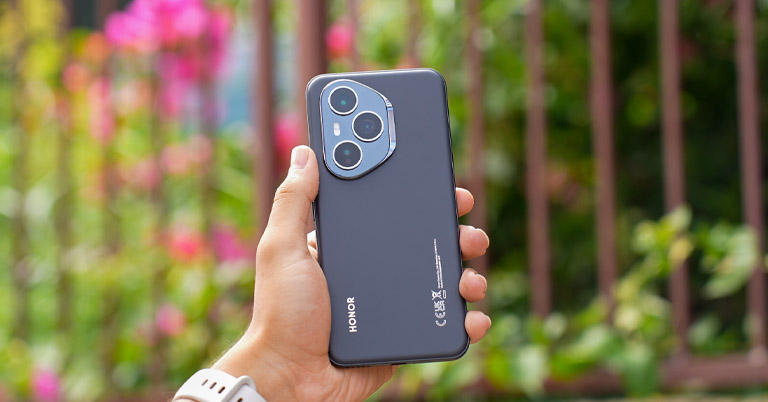
Let’s start with the impression. Holding the Honor 400 Pro in my hands feels premium, I must say. The design itself has improved dramatically from the 200 Pro. That odd egg-shaped camera module from last year is gone, replaced with a sleeker, more refined layout inspired by Huawei’s Pura series. But I still feel a metal frame would have been a cherry on the cake. By the way, its successor– the Honor 500 Pro comes with an aluminum frame.
Likewise, the phone does feel a bit bulky, but for someone with large hands, it’s not that much of an issue. But if you have small ones, I can’t say the same. But the curved middle frame makes it pretty handy to hold overall. And the reassuring IP68/IP69 water- and dust-resistance has saved me a few times from accidental splashes. Overall, the design segment gets some praise.
Display
Okay, now, the next thing that impressed me is for sure the display. The curved 6.7-inch AMOLED display pops with colors, and the 120Hz refresh rate makes scrolling through social media feel buttery smooth. There are three modes to choose from:
- Dynamic Mode: It can get you up to 120Hz refresh rate, but only in select spots like the home screen and launcher. While using social media, it dials down to 90Hz.
- Standard Mode: It's the static 60Hz for everything, which I don't really recommend for a phone of this caliber. Just ruins the smoothness and fun, which you can leverage effortlessly.
- High Mode: Gives you 120Hz smoothness across the screen except when playing videos, but consumes more battery.
Watching YouTube or Netflix at peak brightness with HDR is a treat – even on a sunny balcony, the screen doesn’t wash out. Even for the other tasks, the display feels solid. Honor also offers AI Super-Dynamic and AI Vivid technology, which makes the content extra punchy, but I just like the default settings anyway.

Talking of the screen protection, it doesn't have that Gorilla Glass Victus 2 level one, but I trust Honor’s own glass protection; they have used it here. It’s prone to scratches but is drop-resistant. Let me tell you, I haven't dropped this guy on purpose—except for some times when it got slipped and sustained no damage.
Likewise, the optical fingerprint sensor is just fine, but an ultrasonic option would have been much better for the price.
Performance
Performance-wise, the Honor 400 Pro feels like it’s built for the long run. The Snapdragon 8 Gen 3, combined with 12GB of RAM and UFS 4.0 storage, means apps open instantly, multitasking is seamless, and even demanding games run smoothly. I played PUBG at 120fps and Genshin Impact at 60fps on max settings without any lag or heating issues – something that really impressed me over these months.

Even after weeks of installing new apps, testing AI features, and gaming sessions, the phone hasn’t slowed down at all. The Snapdragon 8 Gen 3 is a reliable performer, without a doubt.
But the haptic feedback on this guy feels buzzy, which is kind of disappointing. Even the Nothing Phone (2a), which costs half the price, has better haptics. So, I really hope things will change with the upcoming Honor 500 Pro.
Software
On the software side, Honor has improved from previous versions. MagicOS 9.0 feels more mature than last year, and its promise of six years of updates is unrivaled in this segment. Over the past few months, I’ve seen minor performance and security updates, and the phone continues to feel snappy. The AI features are genuinely useful: deepfake detection during video calls gives me a sense of digital security, animating old photos into 5-second videos is surprisingly fun, and the AI typing tool is handy when writing emails or posts.

The “knock to screenshot” feature makes sharing content quick and intuitive. Still, if you’re used to Samsung or OnePlus, the UI feels slightly less polished. App transitions aren’t as smooth, and the icons and animations don’t quite have that premium feel, but it’s not frustrating enough to ruin the experience. So, I’d still choose OneUI over MagicOS. Maybe things will change with MagicOS 10, which is yet to arrive for this device.
Camera
Now, let’s talk about cameras – the feature that really sets this phone apart in its price segment.
Main Camera
The 200MP primary sensor takes some nice daylight shots. I’ve captured street scenes, sky, and landscapes, and the level of detail is amazing. That said, it’s not perfect. Sometimes, when shooting against bright sunlight, the highlights roll off, and a photo can look a bit overexposed.
Ultrawide
The 12MP ultra-wide lens is reliableand great for travel photos and wide landscapes, but it’s not at the level of a flagship phone.
3X Telephoto
Meanwhile, the 50MP 3X telephoto lens does a solid job. When the sun is bright, the 3X zoom shots look pretty decent, with enough detail and sharpness, but in a shadowy place, they are slightly compromised.
3X Portraits
Since the Honor 200 Series, Honor has nailed in the 3X portraits game and continues doing the same on the 400 Pro. Portraits look good most of the time, and the black-and-white Harcourt filter remains my personal favorite for moody shots.
6X Portraits
Honor offers up to 6X zooming for portraits that work well in broad daylight, with good enough detail for social media posting.
Selfies
Selfies are wide, natural, and flattering, which I’ve appreciated for social media and video calls. But it's not that in the league of flagship cameras.
Night Mode
You also get a dedicated night mode that preserves better highlights and shadows. Overall, it's on the decent side, not the best though.
Videos
Video recording is stable and colorful, with main and telephoto cameras capable of 4K 60fps – it’s not cinematic-grade, but more than enough for vlogs or family videos. The cameras have improved slightly with software updates over the months, but I’m hoping Honor continues refining the exposure and highlight handling.
Battery
Moving on, the 6000mAh Si-Ca battery is another highlight. I can go a full day of use and still have 25-30% left by bedtime, even when using the High refresh rate settings. While if you set the settings to Dynamic, the battery life gonna get even better. Overall, I have no complaints whatsoever about the battery side.

When it does need charging, the 100W wired charger is high-speed, topping up 0 to 100% within an hour. Plus, this phone also supports PPS charging, so my 100W multi-port Ugreen Uno charger also comes in pretty handy. The 50W wireless charging is convenient, but I don't have the Honor's charging stand to give it a go.
Connectivity
Okay. I’d also like to talk about this device's connectivity. You might already know that Honor phones are known for having strong cellular reception, and this proved to be true during my usage. It easily provided a good connection in dead WiFi zones in my home, which was not the case with other phones that I have used in the past. Also, while strolling through the alleys of Kathmandu, the data connection on both NTC and Ncell was generally good. In weaker areas, such as near the ends of cell towers or in busy parts of Kathmandu, the connection can be spotty, though.

Likewise, VoLTE and Wi-Fi calling worked quite well with both carriers, but I genuinely miss carrier video calling, which is absent from nearly every Honor phone released in Nepal. For your information, carrier video calling currently works only on NTC, allowing you to make video calls without Wi-Fi or mobile data. Moreover, Bluetooth 5.4 connectivity functions well. This phone also supports the APTX codec, so listening to music with my HiFuture Yatch TWS was a great experience. But I did find a bug that has been prevalent in all Honor phones. The default call app marks every phone call as a VoLTE call, even though it's not, like calling from my VoLTE-enabled device to a non-VoLTE handset, for instance. You need VoLTE on both ends to mark a call as a VoLTE call, as simple as that!
Honor 400 Pro Long-Term Review: Conclusion
After months of real-world use, the small compromises become clear. The stereo speakers are decent but not immersive, and the optical fingerprint sensor is less reliable with wet fingers. Minor scratches have appeared on the glass, and while the vibration motor works fine, it lacks the tactile punch of a true flagship. Yet, none of these are deal-breakers because the core experience – performance, display, battery, cameras, and software updates – more than makes up for them.

In conclusion, the Honor 400 Pro proves that a midrange phone can offer a near-flagship experience in real-world use. It’s fast, reliable, and built for the long term. If you want a bright, smooth AMOLED display, massive battery, strong cameras, Snapdragon 8 Gen 3 performance, IP68/IP69 durability, and six years of updates – all in a phone under NPR 90,000 – the Honor 400 Pro is hard to beat. Months in, it still feels fresh, capable, and impressive, making it a smart choice for anyone in Nepal looking for a premium long-term device.
Honor 400 Pro Long Term Review: Pros and Cons
Pros:
- Elegant design
- Superb display and battery life
- Strong performance
- Eye-catching portraits
Cons:
- Average stabilization on the ultrawide camera
- Weak haptics
- Okayish software experience
Article Last updated: December 13, 2025