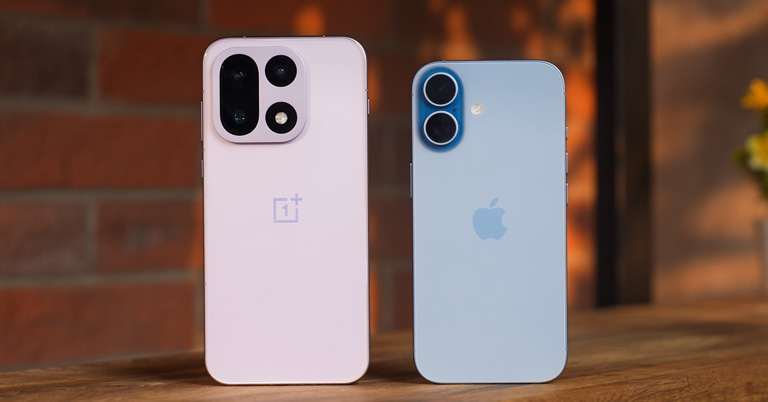
I decided to compare two phones that have been making serious noise in the market: the iPhone 17 and the OnePlus 15. The hype surrounding both of these is massive. Apple has brought its biggest set of upgrades since the iPhone 11 with this iPhone 17, and reports are coming in that it’s absolutely killing it worldwide in sales. But OnePlus has seriously stepped up, too, bringing aggressive upgrades across almost every aspect of the new OnePlus 15 to make it tough competition. So, for around NPR 1,60,000 in Nepal, which one should you actually buy? That’s the question I’m going to answer for you in this article.
iPhone 17 vs OnePlus 15 Specifications
| iPhone 17 | OnePlus 15 | |
|---|---|---|
| Design, build | 149.6 x 71.5 x 7.95 mm, 177 gm, IP68 rating | 161.42 x 76.67 x 8.10 mm, 211g (Sand Dune), Aluminum frame, Fiberglass back, Glass front, IP69 and IP69K water resistance |
| Display | 6.3-inch OLED screen, FHD+, 120Hz refresh rate (LTPO) | 6.78-inch BOE X3 OLED, 1,272 x 2,772 pixels (FHD+), 1–165Hz variable refresh rate, 1,800 nits peak brightness, 450 ppi |
| Chipset | Apple A19 (3nm mobile platform) | Snapdragon 8 Elite (Gen 5), Adreno 840 GPU |
| Memory | 8GB RAM, 256/512GB storage (non-expandable) | 12GB/16GB LPDDR5X RAM, 256GB/512GB/1TB UFS 4.1 storage |
| Software & UI | iOS 26 | OxygenOS 16 (Global) / ColorOS 16 (China), Based on Android 16 |
| Rear Camera | Dual (48MP primary, 48MP ultrawide) | Triple: 50MP primary (Sony LYT-700), 50MP ultrawide (OV50D), 50MP periscope telephoto (3.5x optical zoom), 8K 30fps and 4K 120fps video |
| Front Camera | 18MP "Center Stage" camera (Dynamic Island) | 32MP IMX709, Up to 4K 60fps video |
| Security | Face ID (via the front camera) | Ultrasonic in-display fingerprint sensor |
| Connectivity | Dual-SIM (Nano), WiFi 7, Bluetooth 6, GPS / Glonass / Galileo / BeiDou / QZSS / NavIC, USB-C, 4G LTE, 5G | 5G, Wi-Fi 7, Bluetooth 6, NFC, USB 3.2 Gen 1, Navigation: Beidou, GPS, GLONASS, Galileo, QZSS |
| Sensors | Accelerometer, Barometer, Dual ambient light, Gyroscope, Proximity | Proximity, ambient light, color temperature, compass, accelerometer, gyroscope, hall, laser focus, spectrum, IR blaster |
| Battery | 3,692 mAh with 25W wireless charging (no power adapter in the box) | 7,300mAh capacity, 120W wired charging, 50W wireless charging |
iPhone 17 vs OnePlus 15 Review
Price and Availability
Starting with the price, the OnePlus 15 (16+512GB) variant is priced at exactly NPR 1,60,000, while the iPhone 17 (256GB) variant is slightly cheaper at NPR 1,57,300. Both phones can be bought on EMI, but the process is definitely easier with the OnePlus, which just requires your citizenship card. For the iPhone, you’ll need a credit card to complete the EMI process.
Design and Build
The very first thing you notice is the design, and this is where we start. The single biggest difference between these two phones is the size. The iPhone is compact and neat—it’s perfect for people like me who have smaller hands. The OnePlus 15, on the other hand, feels like the iPhone 17’s older brother; it has a huge display and a massive 7,300 mAh battery packed inside.
Size aside, the aesthetics are pretty much the same: flat, boxy designs with metal frames and that matte-finish glass back, and the feel of both is definitely premium. In terms of durability, they are equally tough. The iPhone 17 is rated IP68, meaning it can withstand 30 minutes in up to 6 meters of water. The OnePlus 15 is even stronger, featuring IP68, IP69, and IP69K, which means it can handle 30 minutes in 2 meters of water and high-pressure water jets.
This might sound cliché, but ultimately, deciding which design is better comes down to personal preference: if you like a compact phone, the iPhone 17 is the clear winner, but if you prefer a large screen, the OnePlus is the obvious choice. I personally found myself liking the OnePlus design more this time, mainly because the Black color gives off a distinct Batman-like vibe and the hand feel is excellent. The camera module is nicely integrated, and even though it’s a big phone, the weight distribution is remarkably good, unlike some of the heavily top-weighted flagship camera modules from Vivo or OPPO. The iPhone design hasn’t really changed since the iPhone 16, so for me, it’s the OnePlus that wins the design round.
Display and Haptics
When you’re paying NPR 1,60,000, you expect a killer display. Turning the phones over, Apple has finally listened to years of criticism and given the base iPhone 17 a 120 Hz refresh rate, so I honestly don't have many complaints about the iPhone 17's display this year—it has great quality, excellent touch response, and it's plenty bright, offering a smooth experience.
However, the OnePlus has made nearly double the improvements. While the resolution is only 1.5K now instead of the older 2K, the overall experience is better. For starters, the 165 Hz refresh rate provides a much smoother feel than the iPhone 17 when opening apps or scrolling, and the screen is bigger, which will be felt while watching your favourite movies.
OnePlus also added a dedicated display chip for better touch response, and I did feel that the touch response was superior to the iPhone 17. Beyond that, the OnePlus 15 features higher-frequency PWM dimming and supports both HDR10+ and Dolby Vision, while the iPhone 17 only has Dolby Vision and lacks the high-frequency PWM dimming.
Both phones have fantastic brightness, with one being slightly brighter in some conditions than the other, but overall, both are very good with no complaints. There was a lot of talk about the anti-reflective coating on the iPhone 17, but it's honestly not on the level of the S25 Ultra, so I don't give it much importance.
Haptics
Moving to haptics, both are great, but the OnePlus’s are more impactful and precise, and better integrated with the UI. The main issue with the iPhone is that you cannot adjust the vibration intensity from the settings, which you can do on the OnePlus. The speaker on the OnePlus is louder, but the iPhone 17’s speaker is more balanced and fuller, so in terms of speakers, I choose the iPhone.
Performance
Next, let's consider which phone provides a better daily experience, and here I definitely pick the OnePlus 15, primarily because the Oxygen OS experience is fantastic in several key areas. App opening is incredibly fast on the OnePlus 15, it can keep more apps running in the background for a longer time, and multitasking feels smoother and faster overall.
The OnePlus also has superior hardware, utilizing the latest Snapdragon 8 Gen 5 Elite processor, while the iPhone 17 gets a slightly downgraded A19 chip (the Pro model gets the A19 Pro with an extra GPU). So, while the CPUs are similar, the GPU on the OnePlus is far superior.
Pairing that with the 165 Hz display means the OnePlus 15 also provides smoother gaming, with almost all games running at 120 fps and some even hitting 165 fps. The iPhone 17 limits games to a maximum of 90 fps (like PUBG), while the OnePlus can reach 165 fps using frame interpolation. Plus, the larger display simply makes gaming more enjoyable.
Another advantage, which may not matter to everyone, is that the OnePlus 15 has USB 3.2 support, while the iPhone only has slower USB 2.0. This makes copying files from an SSD to the phone incredibly fast on the OnePlus 15—it's a night-and-day difference.
Software
Since it's almost 2026, AI features are crucial, and in general, Android's AI is much better than Apple's. Siri struggles to answer simple questions, like "When did Lionel Messi score his last goal?" while the OnePlus has Gemini built-in and easily handles such small questions. Features like Circle to Search are also more intuitive on Android—you just long-press the bottom bar—whereas the iPhone requires you to take a screenshot first, which is inconvenient.
Oxygen OS 16 includes several very useful tools, such as the File Dock, which I use a lot, and a writing assistant built right into the keyboard. The iPhone's AI writing, by comparison, is only available in the Notes and Reminders apps. I also love the Mind Space feature on the OnePlus, where you can long-press the side button to save a voice memo or single-tap to take a screenshot, and all this information is stored and can later be queried using Gemini. It doesn't work perfectly, but it will improve eventually. The iPhone's software isn't bad—it's highly optimized, and apps like Messenger, Instagram, and Snapchat run better on it—but for me, using Oxygen OS 16 is simply more exciting.
Battery and Charging
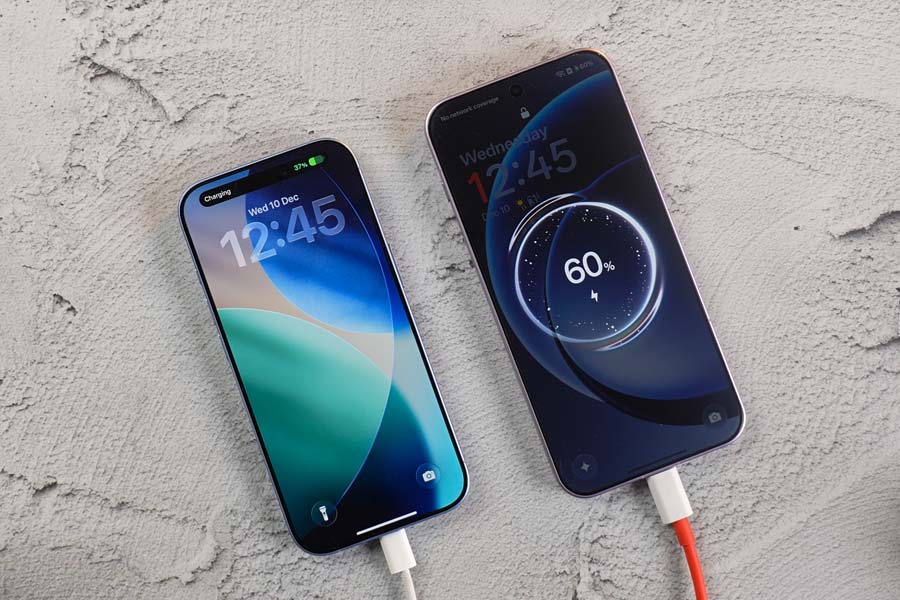
Moving on to another vital aspect, battery life, the OnePlus crushes the iPhone here, too. It has a large 7,300 mAh battery, which is nearly double the size of the iPhone 17's, resulting in me getting 30% better endurance with the OnePlus 15. The iPhone gave me 6-8 hours of screen-on time, while the OnePlus consistently delivered 10 to 12 hours. Charging is also much faster on the OnePlus; the included 100-watt charger gets it to full in about 45 minutes, while the iPhone's 40-watt charger takes a solid hour. Wireless charging is also faster on the OnePlus.
Camera
Up to this point, the OnePlus 15 has largely outperformed the iPhone 17 in nearly every category, but the camera is where the OnePlus falls short. Surprisingly, OnePlus downgraded the camera specs this year, using smaller sensors and removing the Hasselblad partnership in favor of their own "Detail Max Engine," which hasn't notably improved color reproduction.
As a result, even after two software updates, the colors in photos from the OnePlus 15 are only decent; it struggles to represent true red, blue, and green colors well. The iPhone, in contrast, produces consistently true-to-life colors.
Even looking at ultra-wide images, the iPhone’s photos are wider and have balanced colors. Looking at some of these pictures reveals that OnePlus generates yellowish pictures, while the iPhone’s color is better, and the output is wider.
To be fair, the iPhone’s camera doesn't always produce the best output; sometimes I prefer the OnePlus's punchy contrast, and its increased saturation can occasionally make photos, especially at night, more striking compared to the iPhone.
In the selfie department, the iPhone's results are definitely better. The OnePlus 15 makes the face unnecessarily red, and its shadow processing isn't good, while the iPhone produces better selfies, and the new 18 MP camera provides a better field of view. You also get better dynamic range and colors in selfie videos with the iPhone 17.
Overall, in videography, the iPhone predictably delivers better results with superior stability, a wider field of view, and general video smoothness. However, the OnePlus 15 does excel in a couple of ways: first, it supports 4K 120 fps recording, which the iPhone 17 does not, and second, it features an extra 3.5x zoom lens that allows for better subject focus and background blur in portraits.
I found the OnePlus's 3.5x portraits much more attention-grabbing than the iPhone's 2x portraits, with better contrast and skin tone. That extra telephoto lens also allows for better sharpness in zoomed-in photos, preserving details well, and it can take macros, offering far better subject focus than the iPhone.
iPhone 17 vs OnePlus 15 Review Conclusion
To conclude this comparison, if you look at the scoreboard, the OnePlus 15 has crushed the iPhone 17 in almost every aspect—design, display, performance, battery life, and even software and AI. It truly scored at a flagship level. The only weak point for the OnePlus is its camera; if the camera had been better, the OnePlus 15 would have been the ultimate all-rounder of the year—it would have had everything. Regarding the iPhone, it scores consistently well across the board; it’s a reliable phone.
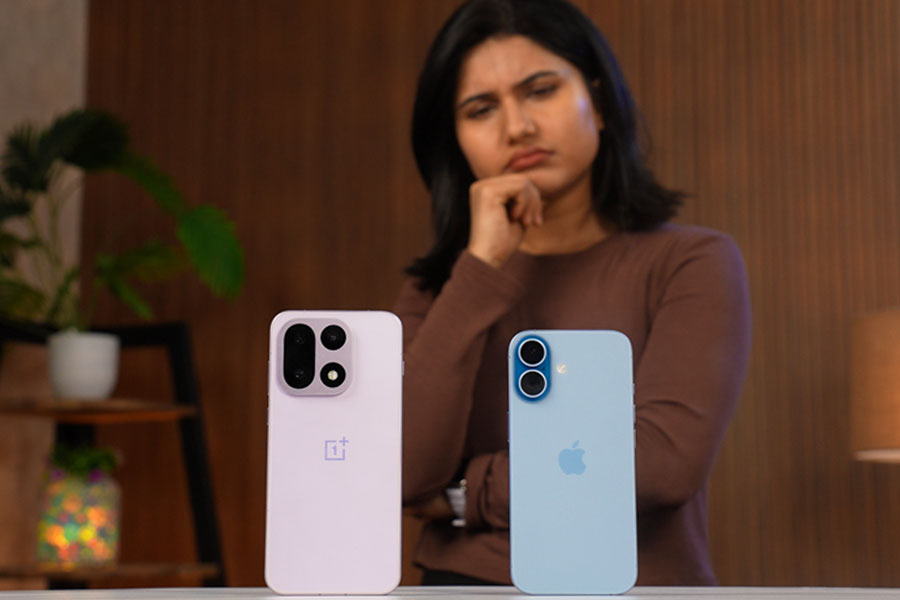
And honestly, iPhone 17 buyers aren't going to consider the OnePlus 15 no matter how good it is. If you've decided on an iPhone, the iPhone 17 is a balanced phone. But in my opinion, if I had to choose, the OnePlus 15 provides the best overall smartphone experience, the best performance (especially while gaming), the best battery life, and an incredible display experience. I was seriously impressed with this phone!
| iPhone 17 | OnePlus 15 | |
|---|---|---|
| Design & Build | 8.5 | 9.0 |
| Display | 9.0 | 9.5 |
| Performance | 8.0 | 9.5 |
| Battery | 7.0 | 9.5 |
| Audio & Haptics | 8.5 | 8.0 |
| Software | 8.0 | 9.0 |
| Rear Cam | 9.0 | 7.5 |
| Front Cam | 8.5 | 7.0 |
| Value for Money | 7.5 | 9.0 |
Article Last updated: December 15, 2025
![Top Ride Sharing Apps in Nepal [Updated]](https://media.gadgetbytenepal.com/2026/03/Top-Ride-Sharing-Apps-in-Nepal.jpg)