FIFA World Cup 2026 costs extra on IPTVs/ cable TV in Nepal. Here’s why legal access feels expensive, why piracy blocks may not work, and why this World Cup is already con
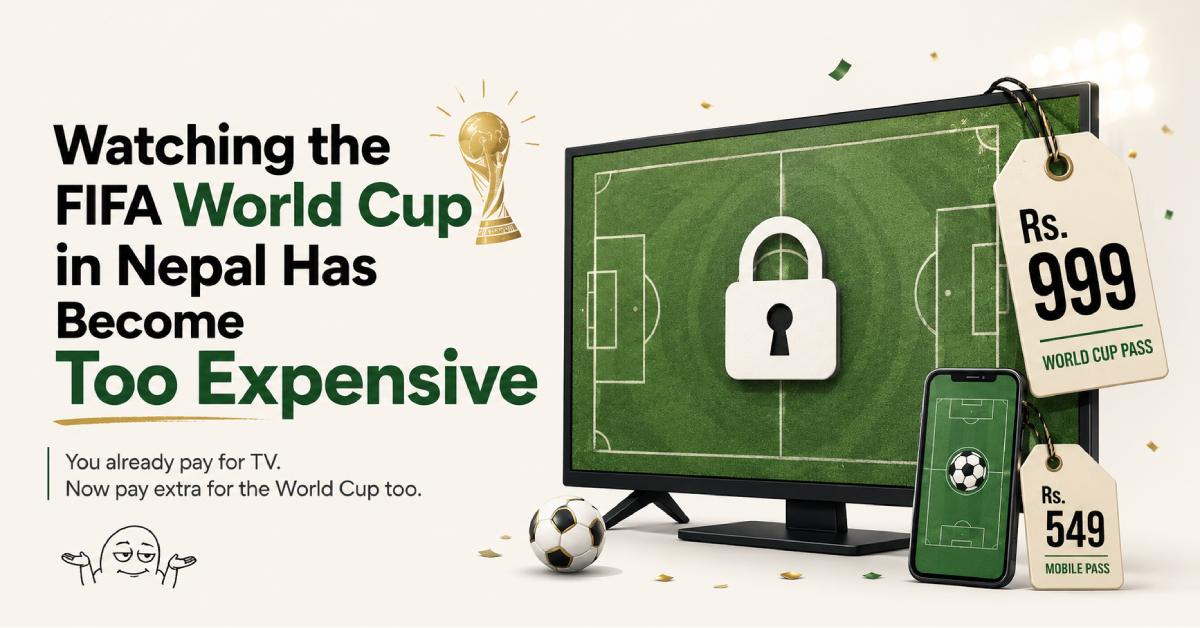
Watching the FIFA World Cup in Nepal should have been simple. You already pay for internet. You already have NETTV, ViaTV, DishHome, or some other IPTVs/ cable TV service at home. So naturally, you would expect the biggest football tournament in the world to be included in your regular TV package. But that is not the case. For FIFA World Cup 2026, Nepali viewers have to pay an additional World Cup subscription on top of their regular TV or internet package.
FIFA World Cup 2026 Price in Nepal: Regular TV Package Is Not Enough
Even if you already pay around Rs. 300–350 per month for your TV package, that does not mean you automatically get to watch the FIFA World Cup. On most platforms, the World Cup has been separated as a special Pay-Per-View or season-pass package.
| Package | What it gives | Price |
|---|---|---|
| Regular NETTV / Via TV package | Normal TV channels and platform access | Around Rs. 300–350/month, depending on package |
| WorldLink NETTV Football 2026 Pass | FIFA World Cup 2026 access on Himalaya Sports HD | Rs. 999 |
| Nepal Telecom NTTV World Cup Package | FIFA World Cup 2026 access on Himalaya Sports HD | Rs. 999 |
| Vianet ViaTV World Cup Coupon | FIFA World Cup 2026 access on Himalaya Sports HD | Rs. 999 |
| DishHome TV World Cup Season Pass | FIFA World Cup 2026 access for the tournament | Rs. 999 |
| DGO Mobile World Cup Pass | FIFA World Cup 2026 access on mobile only | Rs. 549 |
So whether you are on NETTV, NTTV, ViaTV, or DishHome TV, the World Cup is not simply included in your normal TV subscription. You still have to pay extra.
Why Paying Extra for the World Cup Feels Unfair
Yes, Rs. 999 technically gives access to all 104 matches. If we divide it match-by-match, it may not sound expensive at all. But that is not how consumers think. For a Nepali household, Rs. 1,000 is still Rs. 1,000. And when people are already paying monthly fees for TV and internet, asking them to pay another separate amount just for one tournament feels costly.
This felt especially strange to me because, for many years, I never had to pay a separate fee to watch the FIFA World Cup on TV.. It used to be available through regular television channels, and for many viewers, it was part of the normal TV experience.
Football is one of the few global events where everyone, from kids to office workers to casual viewers, wants to be part of the same moment. But this year, watching the World Cup legally in Nepal feels more like buying a premium add-on than enjoying a global sporting festival.
Is It the Fault of IPTVs/ Cable TV?
I do not think we can put all the blame these Nepali IPTVs/ cable TV platforms. These companies are most likely trying to recover what they paid for the rights, as broadcast rights are not cheap for this year's World Cup. And Nepal is not a huge advertising market where broadcasters can easily recover massive costs from sponsorship alone.
So, from a business point of view, I understand why the local rights holders are charging extra. But from a consumer point of view, the pricing still feels high. The bigger issue seems to be FIFA’s broadcast-rights strategy.
FIFA’s Expensive Broadcast Rights Are the Bigger Problem
This year, even big markets like India and China faced complications. In India, the broadcast deal was reportedly finalized very late after a long negotiation, with FIFA initially demanding a very high amount. Broadcasters were reluctant because the value did not seem to match the cost. China also had its own late-stage rights negotiation before the broadcast deal was finalized.
One major reason is timing. Since the World Cup is being hosted in the US, Canada, and Mexico, many matches air late at night or early in the morning in Asia. That means weaker prime-time viewership and weaker advertising value. If your audience is watching at 1 AM, 4 AM, or 7 AM, the commercial value is not the same as a prime-time event.
Why Blocking Illegal Streaming Sites Will Not Fully Solve Piracy
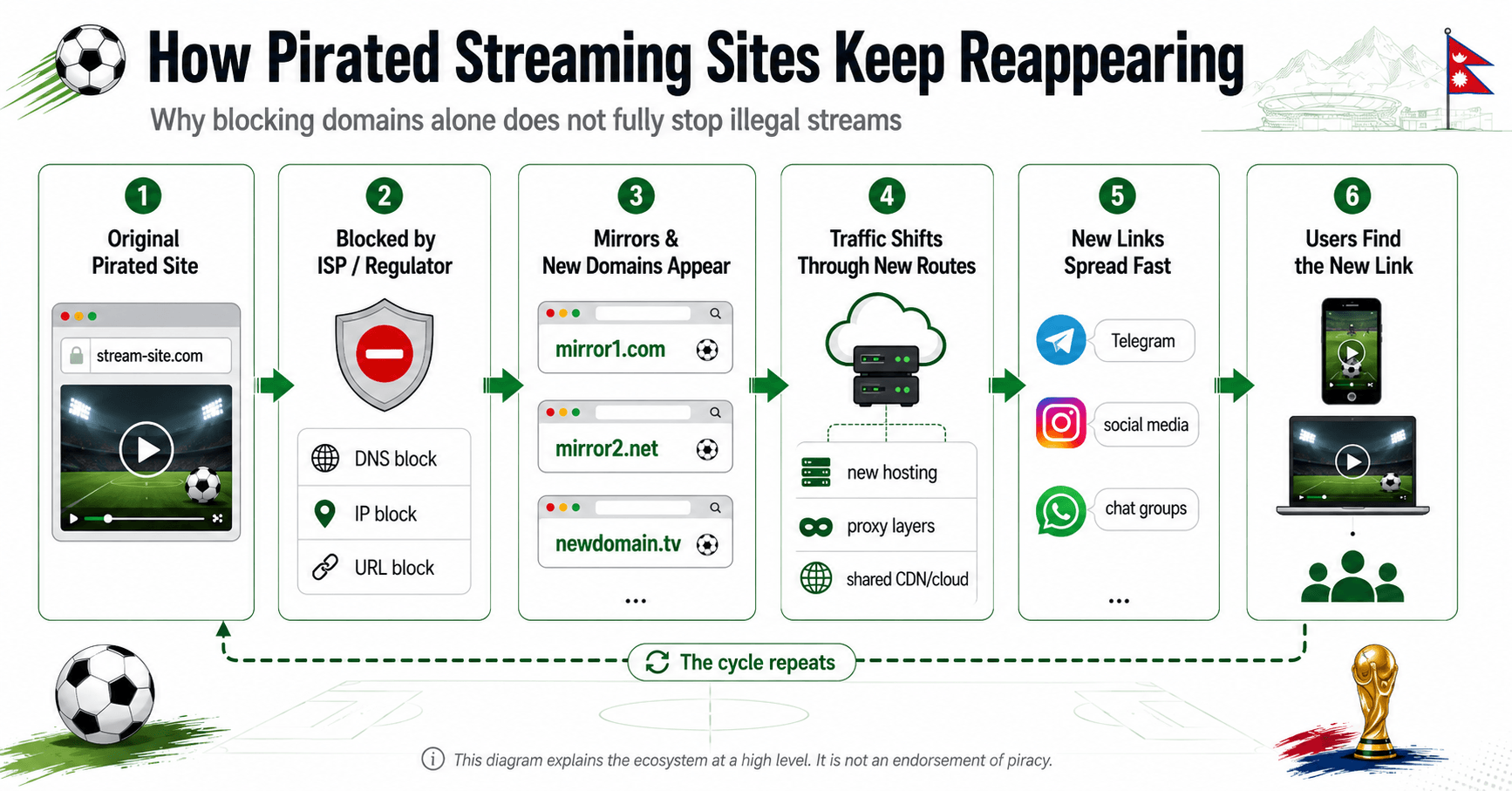
The Nepal government and regulator have reportedly moved to block dozens of illegal streaming websites and apps for unauthorized World Cup streaming. But I do not think this solves the real problem. Yes, you can block a website. You can block a domain name. You can ask ISPs to restrict access. But illegal streaming websites do not work like traditional TV channels.
They constantly change domains, create mirror links, use proxy servers, and move traffic through different routes. This is exactly how torrent sites, illegal movie-streaming sites, and sports piracy sites have survived for years. If one link is blocked, another link appears.
Technically, ISPs can block access through DNS filtering, IP blocking, or URL filtering. But none of these methods is perfect. Users can change DNS, use VPNs, find mirror sites, or follow new links shared on social media and messaging apps. And if blocking is done aggressively, there is also a risk of blocking legitimate services that share the same cloud or CDN infrastructure.
So can Nepal block some illegal streaming sites? Yes.
Can Nepal completely stop illegal World Cup streaming? Realistically, no.
At best, these blocks make piracy slightly inconvenient. They do not kill piracy. The better long-term solution is not just blocking illegal sites. The better solution is making legal access affordable, simple, and convenient.
Because this is the reality: when legal access is reasonably priced, most people prefer the legal option. But when legal access feels expensive, fragmented, and device-restricted, people start looking for alternatives. That does not make piracy right. But it does explain why piracy becomes attractive.
Final Thoughts
For Nepal, the issue is not just that the World Cup costs Rs. 999. The bigger problem is that football fans already pay for TV, already pay for internet, and still have to pay extra for the biggest football event in the world.
Again, I understand that local companies need to recover rights costs. I do not think this is only their fault. But as a viewer, I still feel the pricing is too high for Nepal. The World Cup should not feel like a luxury add-on. It should feel accessible.
Football is called the world’s game for a reason. But if watching it legally keeps becoming more expensive every tournament, then somewhere along the way, the world’s game starts moving away from ordinary fans. And that is the real disappointment.
Article Last updated: June 12, 2026



![Samsung Mobile Price in Nepal [Updated 2026]](https://media.gadgetbytenepal.com/2026/06/Samsung-Mobile-Price-in-Nepal-2026.jpg)